

Everyone talks about compounding. Few actually practice it.
It’s the first concept investors learn, and the last they truly understand.
We celebrate it when markets rise, quote it when they fall, and use it to justify patience. Over time, compounding has turned from a principle into a slogan - repeated so often that we forget what it really asks of us.
Because compounding isn’t a guarantee that time will make you rich, it’s a test - of whether your choices can outlast your emotions.
This edition breaks it down into three ideas:
Seeing compounding through the right lens
What we actually control
Why patience is the hardest part
The Engine Beneath the Math
At its core, compounding is mechanical.
The entire process sits inside one small equation:
A = P × (1 + r/100)ᵗ
A is the outcome - the wealth we hope to see.
P is the capital we commit.
r is the return we chase.
t is the time we stay invested.
The math is simple, but the message is not.
Every letter stands for a decision - when to begin, how much to commit, how long to hold, and how much uncertainty to accept. Compounding isn’t arithmetic; it’s behaviour.
Most investors view it as a law of finance. In reality, it’s a law of discipline.
And that discipline begins with understanding what we can - and cannot - control.
The Illusion of Control
When people think about compounding, their focus goes straight to r, the return.
It’s the most visible part of the equation - the one in every advertisement, chart, and headline. So we chase it relentlessly, switching funds, tweaking portfolios, reacting to every piece of news, hoping to earn a slightly higher return.
But r is the one thing we don’t control.
It depends on the economy, markets, sentiment, and a hundred other forces beyond our reach. Yet, it’s where most of our energy goes.
The parts we do control - P (the money we invest) and t (the time we give it) - are quieter but far more powerful.
P: The consistency to keep adding capital, even when markets feel uncertain.
t: The patience to stay invested, even when the urge to “wait and watch” grows stronger.
Together, they decide how much of compounding’s magic you actually capture.
Proof in the numbers
Example 1: Disciplined investing creates exponential outcomes
Two investors, both earning 12% annually for 20 years.
Investor A invests ₹2 lakh every month, consistently.
Investor B starts with ₹2 lakh but increases it by 10% every year.
Both stay invested for 20 years.
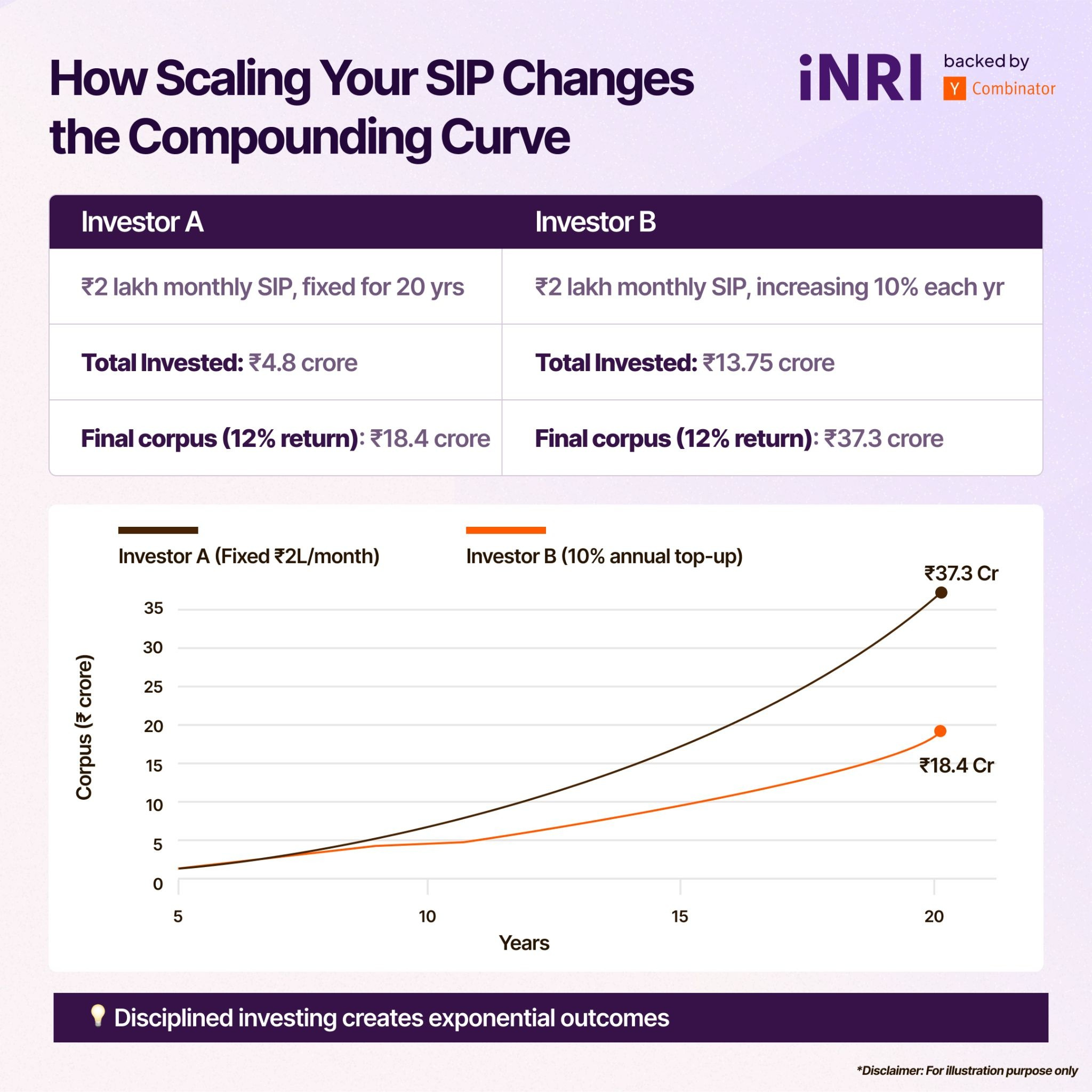
Same market. Same return. Same duration.
The difference: one kept feeding the engine. That 10% yearly top-up nearly doubled the outcome.
Example 2: Consistency is the silent force behind compounding.
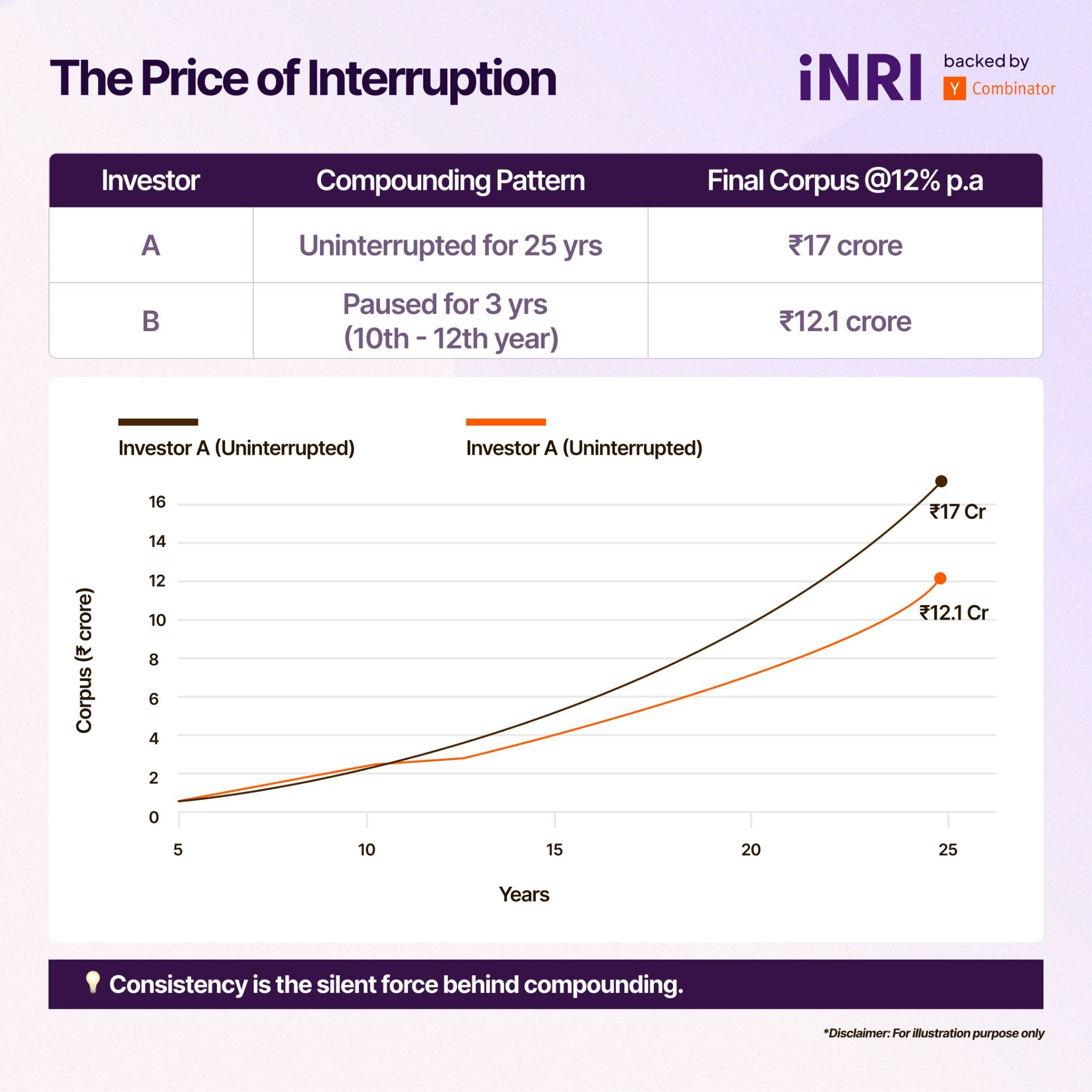
Now flip the lens. Imagine two investors, each starting with ₹1 crore and compounding at 12% for 25 years.
The first stays invested throughout - ends with about ₹17 crore.
The second withdraws for three years midway - ends with ₹12.1 crore.
Same return, but ₹5 crore lost - not because of performance, but interruption.
The Patience Problem
If compounding were just about numbers, everyone would ace it.
But the real challenge is emotional. For a long time, compounding feels invisible. The line barely moves, the rewards feel far away, and the temptation to intervene grows stronger.
We’re wired to equate action with progress. When something matters, we want to manage it closely. In investing, that instinct backfires.
The more we check, the more we react. And every reaction - every tweak, pause, or exit - interrupts the process that was quietly working in our favour.
The best investors aren’t those who outthink the market; they’re the ones who outwait it.
Why Smart People Struggle with Investing?
Successful professionals often struggle most with compounding.
They’re used to control - solving problems, optimising systems, making things happen. In investing, that mindset turns costly.
They track portfolios daily, switch funds often, and chase incremental returns. Ironically, that obsession steals time and focus from what actually grows their wealth - their core work or business.
You don’t get better outcomes by watching your portfolio more. You get them by staying invested and letting specialists handle the mechanics.
Think of it as division of labour:
The fund manager manages the process.
The investor manages the patience.
When both do their part, compounding does the rest.
The Noise Trap
Technology has made investing easier - and staying patient harder.
Every day brings updates, price moves, and opinions that feel urgent. Yet, in most companies, only a handful of days each year actually change fundamentals. The rest is noise.
Still, those are the days when most investors act - reacting to volatility that doesn’t matter.
This is why mutual funds remain one of the simplest, most effective vehicles for wealth creation. Their structure turns volatility into opportunity. They work best when left undisturbed.
Your only job: stay invested long enough for time to do its job.
In summary
Compounding is not a promise. It’s a partnership - between time, capital, and behaviour.
It rewards consistency over brilliance, patience over prediction.
Focus on what you can control:
Keep adding to your capital (P)
Stay invested for longer (t)
Let returns (r) take care of themselves.
Wealth doesn’t grow by reacting to markets. It grows by respecting the two variables that quietly decide everything - time and commitment.